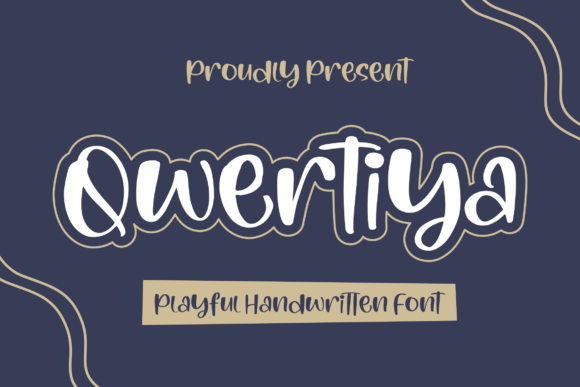
Qwertiya: A Playful Handwritten Font for Makers
It was 10 p.m., and I was finalizing a set of candle labels for a new lavender-vanilla batch—soft blues, creamy kraft paper, and that one line I kept rewriting: “Hand-poured with care.” I’d tried three fonts already. One felt too stiff, another too fussy, and the third vanished entirely when scaled down to fit my 2-inch label template. Then I opened Qwertiya—a Script Handwritten font I’d downloaded on a whim—and typed it in. Instantly, the words softened, warmed, and breathed. That’s when I knew: Qwertiya wasn’t just another pretty Fonts file—it was the handwritten voice my handmade brand had been missing.
Qwertiya for Candle Labels and Product Packaging
I tested Qwertiya across five real packaging formats: kraft sticker sheets, matte-finish product tags, shrink-wrap sleeve mockups, jar lid decals, and shipping box stamps. As a Script Handwritten font, Qwertiya shines brightest at sizes 14–36 pt—ideal for short, evocative phrases like “Small Batch,” “Locally Made,” or “Soy Wax Blend.” Its gentle bounce and subtle contrast give warmth without sacrificing legibility on curved surfaces or textured stock. On my candle jars, the lowercase “g” and “y” add personality without overwhelming; uppercase letters hold strong in logo lockups or monogrammed seals. Just avoid using Qwertiya for ingredient lists or compliance text—it’s a display font, not a body text workhorse. For layered packaging (like a front label + back care instructions), I paired Qwertiya with a clean sans serif—think Montserrat or Poppins—for balance and hierarchy.
Qwertiya for Wedding Invitations and Elegant Branding
For a recent client’s rustic-chic wedding suite, I used Qwertiya across save-the-dates, menu cards, and welcome signage. As a Script Handwritten typeface, Qwertiya carries an effortless elegance—not overly formal, not too casual—just right for couples who want charm without cliché. Its natural flow works beautifully in tight spaces (like folded RSVP cards) and scales gracefully up to 72 pt for acrylic ceremony signs. I especially loved how the included swashes and alternate characters let me customize “Mr. & Mrs.” with a delicate connecting flourish—no extra design software needed. All files came in OTF and TTF, with full commercial licensing, so I could confidently deliver editable templates to my client. Pro tip: test spacing in your layout app before printing—Qwertiya’s generous letterfit means tighter tracking often improves rhythm for titles and names.
Qwertiya for Mugs, T-Shirts, and Shopping Bags
When designing merch for my seasonal shop refresh, I ran Qwertiya through the real-world gauntlet: Cricut cut tests on iron-on vinyl, Silhouette Studio preview renders, and mockup exports for Etsy listing images. As a Script Handwritten font built for impact, Qwertiya holds its shape beautifully—even at 2.5 inches tall on a ceramic mug or across the chest of a relaxed-fit tee. The slight irregularity in stroke weight adds tactility you can almost *feel* in photos, boosting perceived handmade quality. For shopping bags, I used the boldest weight (yes—it includes a bold variant!) for “Handmade With Love” printed on natural cotton canvas. No pixelation, no awkward joins. Just confident, joyful typography. Keep in mind: very fine details (like ultra-thin swashes) may not survive sublimation printing at small sizes—stick to main glyphs for under-1.5-inch applications.
Qwertiya for Printable Wall Art and Digital Downloads
As a printable creator, I rely on fonts that look intentional—not “designed,” but *lived-in*. Qwertiya delivers exactly that. In my latest botanical-themed planner bundle, I used Qwertiya for section headers (“Monthly Intentions,” “Gratitude Pages”), quote overlays on watercolor backgrounds, and even as subtle watermark accents on editable PDFs. Because it’s a well-hinted Script Handwritten font, Qwertiya renders crisply at any resolution—whether viewed on a phone screen or printed at 300 DPI on premium cardstock. It also includes multilingual support (including accented characters for French, Spanish, and Portuguese), which matters when creating global-friendly digital downloads. Bonus: the included ligatures—like “fi,” “fl,” and “ct”—add polish to titles without manual tweaking. Just remember to embed Qwertiya when exporting PDFs for sale, and always double-check licensing terms if bundling it into Canva templates or SVG cut files.
Qwertiya for Book Covers and Name Cards
Last month, I designed a children’s activity book cover—and landed on Qwertiya for the title. Its playful energy, rounded terminals, and friendly baseline sway made “Adventure Time!” feel like an invitation, not an instruction. As a Script Handwritten font, Qwertiya excels at name-centric uses: birthday party banners, baby milestone cards, boutique gift tags, and personalized stationery. I’ve used it for “Emma’s First Day” embroidery patches and “The Smith Family” farmhouse-style wall prints—with consistent charm and zero visual fatigue. For longer text blocks (like back-cover blurbs), I switched to a simple serif—but kept Qwertiya for the author name and series logo. It’s versatile enough to anchor a brand, yet distinctive enough to stand alone. And because it’s a premium Fonts release, I trust its consistency across platforms: Adobe Creative Cloud, Affinity apps, Cricut Design Space, and even Google Docs (via upload).